Groanings Which Cannot be Uttered

Most of us are familiar with the passage below. To understand how it applies to our lives two key words need to be examined: helps and groanings.

26  Likewise the Spirit also helps in our weaknesses. For we do not know what we should pray for as we ought, but the Spirit Himself makes intercession for us with groanings which cannot be uttered. 27  Now He who searches the hearts knows what the mind of the Spirit is, because He makes intercession for the saints according to the will of God. Romans 8:26-27 (NKJV)

The key to understanding the passage is whether the Holy Spirit is interceding for us to the Father or His intercession is through us. The answer is found in the word helps. The word means, “Help, assist, take hold of together, help in obtaining.” (The Complete Biblical Library Greek-English Dictionary). One interlinear translate it as “jointly helps.” What this communicates is that when we are overwhelmed and don’t know where to turn or how to pray, He does. The Holy Spirit dwells in us and is stirred by our needs as He works to conform us to the image of Jesus. Thus He responds by stirring up intercession deep within us. When we look to Him He doesn’t take over, He helps.

The passage says this intercessory help is expressed through, “groanings which cannot be uttered.” For those of us who have seen someone in the grip of intercessory travail it is evident what this passage means. While some interpret it as tongues that does not do justice to the passage. The Greek word is used twice in the NT. Here and in Acts 7:34 when Stephen said the Lord heard the groaning of the Israelites in bondage in Egypt. It carries the idea of deep painful sorrow. 

 So, when we are in a deep struggle we can look to Him and let Him move through our spirit and express our heart in ways we can’t normally release!

Holy Spirit You are Welcome Here

Let’s look briefly at the role of the Holy Spirit in our lives. He is part of the Trinity but scripture tends to focus more on Jesus and the Father. While many books have been written about the Holy Spirit I don’t know how often we think about His role and activity in our lives. For example, there are articles and prayers asking the Holy Spirit to take control of our lives. Yet when we look at the scriptural role He takes on, we are told that part of the fruit of His work in our lives is self-control.

22  But the fruit of the Spirit is love, joy, peace, longsuffering, kindness, goodness, faithfulness, 23  gentleness, self-control. Against such there is no law. Galatians 5:22-23 (NKJV)

The primary role of the Holy Spirit in the lives of believers appears to be that of helping.

15  “If you love Me, keep My commandments. 16  And I will pray the Father, and He will give you another Helper, that He may abide with you forever – 17  the Spirit of truth, whom the world cannot receive, because it neither sees Him nor knows Him; but you know Him, for He dwells with you and will be in you. 18  I will not leave you orphans; I will come to you.” John 14:15-18 (NKJV)

So we see here three things.

  • The Holy Spirit is described as a helper, like Jesus
  • He is the Spirit of truth
  • He is in believers

It has been accurately said that He is the Helper, not the doer. He enables us and when we seek to know Him we encounter truth, support and meet Jesus in Him. Consider the import of, “He dwells with you and will be in you.”

Holy Spirit You are Welcome Here https://www.youtube.com/watch?v=v_LpmqwWhR8

Works Befitting Repentance

While we cannot earn salvation, clearly Paul, and the rest of the letter writers of the NT, expected a change in behaviour as evidence of conversion. Below are two translations of Acts 26:20. The Amplified highlights the expectation of a lifestyle change.

20  but declared first to those in Damascus and in Jerusalem, and throughout all the region of Judea, and then to the Gentiles, that they should repent, turn to God, and do works befitting repentance. Acts 26:20 (NKJV)

20  But made known openly first of all to those at Damascus, then at Jerusalem and throughout the whole land of Judea, and also among the Gentiles, that they should repent and turn to God, and do works and live lives consistent with and worthy of their repentance. Acts 26:20 (AMP)

I write this because we rarely hear repentance spoken of in the church anymore. I cannot remember a single sermon in recent years that has highlighted it. Granted I may have forgotten some, but my experience now is that evangelicals not only rarely talk about it, many will even argue about the need for it, that is, that we just need to trust in grace. My wife and I were recently talking with a couple and the fellow shared about a co-worker who claimed to be born again but was living in a common-law relationship (In modern vernacular, an ‘adult interdependent relationship’). He said he knew it was sin but it was ‘covered by grace.’

I think we need a return to understanding that turning to Jesus means living lives consistent with the gospel. After all, when Paul confronted the Corinthians over their claims to be following Jesus, when their lifestyle choices suggested otherwise, he said the following. 

5  Examine yourselves as to whether you are in the faith. Test yourselves. Do you not know yourselves, that Jesus Christ is in you? – unless indeed you are disqualified. 2 Corinthians 13:5 (NKJV)

How are we doing?

Entering into His Presence

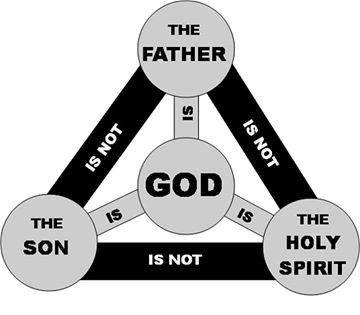
The symbol below is a representation of the Trinity.

Here I am looking at how the Trinity functions and how we are invited in to experience this relationship. I was first exposed to this idea many years ago through the writings of Gene Edwards. He put forth the idea that the Godhead, Father, Son and Spirit had eternally beheld one another with affection and love. I don’t know that we normally think of the Godhead as gazing upon one another but here is a scripture passage.

24  Father, I desire that they also whom You gave Me may be with Me where I am, that they may behold My glory which You have given Me; for You loved Me before the foundation of the world. 25  O righteous Father! The world has not known You, but I have known You; and these have known that You sent Me. 26  And I have declared to them Your name, and will declare it, that the love with which You loved Me may be in them, and I in them.” John 17:24-26 (NKJV)

The reason Edwards raised this was to encourage us to accept the invitation into this same fellowship, as Jesus prayed above, that we would behold His glory. Jesus desires that we would be drawn into this eternal beholding of the Godhead.

John the apostle understood this reality and also invited us to participate.

1  That which was from the beginning, which we have heard, which we have seen with our eyes, which we have looked upon, and our hands have handled, concerning the Word of life – 2  the life was manifested, and we have seen, and bear witness, and declare to you that eternal life which was with the Father and was manifested to us – 3  that which we have seen and heard we declare to you, that you also may have fellowship with us; and truly our fellowship is with the Father and with His Son Jesus Christ. 1 John 1:1-3 (NKJV)

Furthermore as His children we are always in His presence.

7  Where can I go from Your Spirit? Or where can I flee from Your presence? 8  If I ascend into heaven, You are there; If I make my bed in hell, behold, You are there. Psalm 139:7-8 (NKJV)

And He thinks about us.

17  How precious also are Your thoughts to me, O God! How great is the sum of them! 18  If I should count them, they would be more in number than the sand; When I awake, I am still with You. Psalm 139:17-18 (NKJV)

And desires that we behold His glory.

18  But we all, with unveiled face, beholding as in a mirror the glory of the Lord, are being transformed into the same image from glory to glory, just as by the Spirit of the Lord. 2 Corinthians 3:18 (NKJV)

Through seeing Jesus.

6  For it is the God who commanded light to shine out of darkness, who has shone in our hearts to give the light of the knowledge of the glory of God in the face of Jesus Christ. 2 Corinthians 4:6 (NKJV)

How about accepting the invitation and sitting with the Godhead and participating in this eternal beholding? 

Honouring His Presence Part 4 – Accepting His Invitation

Think about Jesus resurrection and the stone being rolled away from the tomb. At Easter we often see images such as the one below. Jesus standing in front of the open tomb with light shining around Him.

These images can be quite moving and it seems that generally the idea is that the stone was rolled away and Jesus burst forth from the tomb. To determine the accuracy let’s look at the scriptures. In the four gospels the most thorough account is in Matthew.

1  Now after the Sabbath, as the first day of the week began to dawn, Mary Magdalene and the other Mary came to see the tomb. 2  And behold, there was a great earthquake; for an angel of the Lord descended from heaven, and came and rolled back the stone from the door, and sat on it. 3  His countenance was like lightning, and his clothing as white as snow. 4  And the guards shook for fear of him, and became like dead men. 5  But the angel answered and said to the women, “Do not be afraid, for I know that you seek Jesus who was crucified. 6  He is not here; for He is risen, as He said. Come, see the place where the Lord lay. Matthew 28:1-6 (NKJV)

When the stone was removed Jesus was already gone. Jesus did not need the stone removed to get out, He had the stone removed so that we could see in and encounter truth! This is similar to the idea inherent in Proverbs that God hides things not from us but for us.

2  It is the glory of God to conceal a matter, But the glory of kings is to search out a matter. Proverbs 25:2 (NKJV)

So, as we seek to see Jesus move in our lives, as we bring Him dreams to resurrect, shackles to break off, let’s begin by accepting His invitation to encounter truth. Let’s honour and embrace the truth of His presence, honour that He is alive and wants to move in our lives. Let’s hear what the angel said, “Come, see…”

Honouring His Presence Part 3 – Honour through Discernment

Paul made an interesting statement about relationships among believers.

16  Therefore, from now on, we regard no one according to the flesh. Even though we have known Christ according to the flesh, yet now we know Him thus no longer. 2 Corinthians 5:16 (NKJV)

I suspect most of us are more familiar with the verse that follows.

17  Therefore, if anyone is in Christ, he is a new creation; old things have passed away; behold, all things have become new. 2 Corinthians 5:17 (NKJV)

Paul’s point seems to be that because we are new creations we need to relate to and ‘regard’ our fellow believers based on who they are as a new creation. This includes the need to discern the gifts and callings they carry and receive accordingly.

When we look at fellow believers with a new creation mindset we can first look for Jesus in them, then honour what He is manifesting in and through them, the primary goal being Himself. I am sure most of us have had the experience of meeting someone and ‘knowing’ they were a fellow Christian. Not because they carried a large bible, wore a cross or had a neon sign on their head. No, our spirit encountered Jesus in them and we had the opportunity to receive from them, encourage their growth and honour the fact that as fellow believers they were carrying His presence.

The type of honouring I described above requires walking closely to His heart in our evaluations of others.

In contrast to what I just shared above, I know there have been times when I judged others wrongly. Okay, a number of times. When we first meet fellow believers if we set aside our initial judgements we have the potential for deep fellowship through following the leading of the Holy Spirit.  

So, let’s look to Him and seek His heart in the knowing of others.

As an encouragement, one way to walk in honour toward others is by cultivating a heart that honours Him first. See the song below.  

Goodness of God https://www.youtube.com/watch?v=n0FBb6hnwTo&fbclid=IwAR2OmrlQU-oeuio958wj93t03L6TIE56A6RAIGe_BPT0IAIyYf6_KodAgxA

Honouring His Presence Part 2 – What Jesus Offers

There is the expression, “You can never go home again.” It is akin to the idea, “You can never step in the same river twice.” Time marches on and we need to recognize the impermanence of moments. However, one would expect Jesus to be welcome at home, He was after all a nice guy. He didn’t bully people while growing up, He was helpful at home and in the community and there were now stories circulating of people being healed by Him. Here is what happened when Jesus spoke at the synagogue upon His return to Nazareth.

18  “The Spirit of the LORD is upon Me, Because He has anointed Me To preach the gospel to the poor; He has sent Me to heal the brokenhearted, To proclaim liberty to the captives And recovery of sight to the blind, To set at liberty those who are oppressed; 19  To proclaim the acceptable year of the LORD.” Luke 4:18-19 (NKJV)

After His testing in the wilderness Jesus returned to Nazareth and stood up and read this passage about the coming Messiah and then told them the scripture was fulfilled, that is, that He was the fulfillment (verse 21). This was Jesus first public proclamation that He was the prophesied Messiah. The response – they marveled at His words and when He challenged them to believe it they were “filled with wrath” (verse 28).

What was the outcome of their response?

5  Now He could do no mighty work there, except that He laid His hands on a few sick people and healed them. 6  And He marveled because of their unbelief. Then He went about the villages in a circuit, teaching. Mark 6:5-6 (NKJV)

When Jesus was not honoured He could do very little in their midst.

It is interesting if we look around at various segments of the body of Christ that those who believe in healing see more of it. Those who believe in spiritual gifts tend to operate in them. This happens because just as Jesus was present in Nazareth, He is also present when believers gather.

20  “For where two or three are gathered together in My name, I am there in the midst of them.” Matthew 18:20 (NKJV)

Jesus reinforced this message just before His ascension to heaven.

18  And Jesus came and spoke to them, saying, “All authority has been given to Me in heaven and on earth. 19  Go therefore and make disciples of all the nations, baptizing them in the name of the Father and of the Son and of the Holy Spirit, 20  teaching them to observe all things that I have commanded you; and lo, I am with you always, even to the end of the age.” Amen. Matthew 28:18-20 (NKJV)

Since Jesus is with us when we gather why not honour His presence and pursue all that He has to offer?

Honouring His Presence Part 1 – Discerning His Body

In 1 Cor. 11:17-34 Paul addresses how we are to partake of communion, the Lord’s Supper. We generally focus in on verses 28-29.

28  But let a man examine himself, and so let him eat of the bread and drink of the cup. 29  For he who eats and drinks in an unworthy manner eats and drinks judgment to himself, not discerning the Lord’s body. 1 Corinthians 11:28-29 (NKJV)

What I want to focus on is the phrase, ‘not discerning the Lord’s body.’ In general I believe the teaching on this addresses the elements, the cracker and grape juice or wine because they represent Jesus broken body and shed blood.

While there is important truth in that in the context of the passage there is a broader application. Paul’s focus is on the behaviour of the congregation as they gather. In the early church they ate a whole meal together. Here is what Paul said of their behaviour.

20  Therefore when you come together in one place, it is not to eat the Lord’s Supper. 21  For in eating, each one takes his own supper ahead of others; and one is hungry and another is drunk. 1 Corinthians 11:20-21 (NKJV)

What concerned Paul was how they were treating one another in the process. They were not discerning Jesus body, that is, the church, and in the process were not honouring Jesus presence among them and within them. Paul’s statement below is a commentary on verses 20-21.

27  Therefore whoever eats this bread or drinks this cup of the Lord in an unworthy manner will be guilty of the body and blood of the Lord. 1 Corinthians 11:27 (NKJV)

I don’t know how often we think about this but our call as Christians is also a call to honour and bless our fellow believers. We have different degrees of relationship with different ones but regardless of the level of relationship the common factor needs to be one of respect and honour. When we do this we discern Jesus body, honour His presence and instead of coming under judgment we open the door to the blessing of more of Jesus presence in our lives.

Are we discerning His body?

Thinking Within

In my last post I referenced the importance of thinking and our imagination. In response a friend posted a comment that included the following, “The importance of a sanctified imagination.” I read this comment and it has been with me for days. In our walk with Jesus our thinking is critical, and is highlighted in Proverbs.

In examining this proverb it is important to compare two versions as when most quote it they refer to how we think in our heart. 

7  For as he thinks in his heart, so is he. “Eat and drink!” he says to you, But his heart is not with you. Proverbs 23:7 (NKJV)

7  For as he thinks within himself, so he is. He says to you, “Eat and drink!” But his heart is not with you. Proverbs 23:7 (NASB)

The NASB is the more accurate translation. The reference is about our inner thoughts. The word translated as heart in the NKJV is actually the Hebrew nephesh, soul.

Proverbs 23:7 is an important verse that presents an important principle in the context of verses 1-2. The context provides both wisdom and warning, for who of us doesn’t entertain the fantasy of knowing the ‘important’ people? Who would not have his ego ‘stroked’ by their attention? Solomon recognized this.

1  When you sit down to eat with a ruler, Consider carefully what is before you; 2  And put a knife to your throat If you are a man given to appetite. Proverbs 23:1-2 (NKJV)

The phrase ‘given to appetite’ translated more accurately would be ‘ruled/mastered by your soul.’ The word ‘appetite’ is also the Hebrew nephesh, soul. Solomon is saying the degree of control our appetites have over us is connected to how we think. This connection leads us to verse 7 which contains a key idea about the impact of our thought life.

If we focus on a soulish desire to be seen as ‘important’ in the eyes of others we will concentrate on their assessments and this is what we will think about. IF we root our thought life in the renewed and renewing mind of Christ, we will embrace His assessment of us.

The importance of this is found in the word translated ‘thinks’ in verse 7. It is the Hebrew word shāʿar and in addition to referring to our thinking also means to act as a gatekeeper. What Solomon is saying is that the way we think, what we open or close the gate to, determines who we are. Years ago I read something by A. W. Tozer talking about taking responsibility for our thought life. He said, “You may not be able to keep a bird from landing on your head but you can keep it from building a nest in your hair.”  

Tozer’s idea echoes Solomon. The enemy or our flesh may initiate things in our thought life. Our responsibility is to shoo them away and close the gate.

Abiding

Jesus said,

4  Abide in Me, and I in you. As the branch cannot bear fruit of itself, unless it abides in the vine, neither can you, unless you abide in Me. John 15:4 (NKJV)

If we want to bear fruit we need to learn to abide. If we approach the metaphor from the perspective of agriculture it is clear that branches that are not connected to life giving vines cannot produce fruit, even though for a season we may be able to produce a semblance of life.

For example, one spring I cut down a large willow tree. I left a four foot portion of the trunk lying on the patio. In a couple of weeks small leaves appeared on the side of the prone trunk. There was the remnant of life in the trunk, but in a few days the leaves withered. The trunk was no longer connected to life giving roots.

Beyond the obvious practical need to abide to produce life, we need to know how to abide. With that in mind I will look at one tool to aid in abiding, our imagination. Isaiah said something very interesting and I have included a couple of translations to bring out the shades of meaning in this verse.

3  You will keep him in perfect peace, Whose mind is stayed on You, Because he trusts in You. Isaiah 26:3 (NKJV)

3  You will guard him and keep him in perfect and constant peace whose mind [both its inclination and its character] is stayed on You, because he commits himself to You, leans on You, and hopes confidently in You. Isaiah 26:3 (AMP)

3  An imagination supported Thou fortifiest peace -peace! For in Thee it is confident. Isaiah 26:3 (YLT)

The Amplified translation brings out the idea of inclination and character while Young’s Literal Translation correctly informs us that the Hebrew word here for ‘mind’ actually refers to our imagination, or more specifically how our thoughts are formed. Our thought life is a powerful tool to deepen our walk with Jesus or draw us away. So, allow me to take the presentation in the different translations above further and offer my own.

3  You will keep him in deep peace, Whose imagination is fixed upon You, Because he trusts in You. Isaiah 26:3

The idea here is the need to take control of our thought life. Doing this requires that we be intentional regarding the use of our mind. My friend Evelyn used to warn me, and others, of the need to avoid passivity in our thought life. We are in a spiritual battle and when we let down our guard and let our thoughts wander we cease to abide. If we recognize what is happening we have an opportunity to pull our thoughts back. When we fix our thoughts on Him He responds by imparting peace to our hearts.